EvaGreen®
A PCR Dye Safe to the Environment
Figure 1. EvaGreen® dye binds to dsDNA via a "release-on-demand" mechanism.
EvaGreen® dye is a next-generation DNA-binding dye with features ideal for use in quantitative real-time PCR (qPCR) and many other applications. Biotium scientists designed the dye by taking into consideration of several essential dye properties relevant to PCR, including PCR inhibition, safety, stability and fluorescence spectra of the dye. The results of our effort is a dye superior to SYBR® Green I and other commercial PCR or high-resolution melt curve (HRM) dyes.1-4
FEATURES
Non-mutagenic, non-cytotoxic and safe to aquatic life for safe handling and easy disposal down the drain.
Far brighter than SYBR® Green I for detecting amplification due to novel "release-on-demand" DNA-binding mechanism.
Low PCR inhibition permitting use of saturation dye concentration for maximal signal and high-resolution DNA melt analysis.*
Electrophoretically separated PCR product visualized directly via a UV box without the need for another gel stain.
Lack of dye migration from amplicon to amplicon enabling detection of multiple PCR products by melt curves.
Perfectly stable during storage or under PCR condition.
Can be used as a general dsDNA-binding dye for DNA quantitation in solution, capillary gel electrophoresis and more.
PCR Performance: A PCR dye emits fluorescence by forming a dye-DNA complex. The interaction with DNA inevitably leads to some PCR interference by a number of ways, including making dsDNA more difficult to melt, promoting primer-dimer formation and/or mis-priming, and dye acting as "road bumps" to slow down the chain extension reaction. PCR inhibition by the dye can be particularly serious at the early stage of PCR, where the dye-to-DNA ratio is high. On the other hand, having sufficient amount of dye in a master mix is important for generating good signal. Thus, an optimal dye concentration must be used in order to attain reliable PCR performance. For many current PCR dyes, such as SYBR® Green I, the optimal dye concentration can be quite low, which limits PCR signal and also makes the dyes unsuitable for high-resolution melt curve (HRM) analysis.4 Furthermore, a master mix with low SYBR® Green concentration may fail to detect multiple amplicons by melt peaks due to dye migration from small amplicons to large amplicons, giving the false result of a clean single amplicon for a PCR that may in effect produces several products.5
EvaGreen® dye is designed using a novel concept of DNA binding via "release-on-demand" mechanism (Figure 1). The dye is constructed of two monomeric DNA-binding dyes linked by a flexible spacer. In the absence of DNA, the dimeric dye assumes a looped conformation that is inactive in DNA binding. When DNA is available, the looped conformation shifts via an equilibrium to a random conformation that is capable of binding to DNA to emit fluorescence. The chemical equilibrium provides a unique mechanism to continuously supply the active form of the dye from the "reserve" (i.e., the dye in looped conformation), as more DNA is formed during a PCR process. Consequently, an EvaGreen® master mix can be formulated with relative high dye concentration to maximize fluorescence signal without PCR inhibition, making the mix suitable for both qPCR and HRM applications (Figures 2).* Moreover, the EvaGreen® dye in the mix is sufficiently concentrated to serve as a DNA gel stain such that PCR product can be directly analyzed by gel electrophoresis without the need for another gel stain. Visit Biotium website for more information on Biotium's optimally formulated Fast-Plus EvaGreen® master mix products.
Unrivaled PCR Performance

Figure 2. Comparison among Fast-Plus EvaGreen® master mix from Biotium and two fast SYBR® Green master mixes from two leading companies (company A and company Q) under similar condition. The inset is an enlarged view of the area near the baseline for better viewing the curve patterns of the much weaker signals of the two SYBR-based master mixes. Amplicon: ATPG fragment of human genomic DNA; instrument: ABI 7900 Fast.
Dye Safety: Another major advantage of EvaGreen® dye over other PCR and HRM dyes is its safety. EvaGreen® dye is the first and only PCR dye to date designed to be environmentally safe. Very few PCR dyes have been thoroughly studied for their safety despite the increasing use of PCR in research and diagnostics and the fact that DNA-binding dyes are inherently dangerous due to their potential to cause mutation. Thus, handling and disposal of PCR master mixes can be a health and environmental issue. Indeed, SYBR® Green I is found to be even more environmentally toxic than ethidium bromide, one of the best known mutagen.6 SYBR® Green I has been suggested to interfere with the natural DNA-repair mechanism in cells and as a result it potentiates genotoxicity of chemicals as well as DNA damage by UV light. Although no safety data are available on other PCR and HRM dyes (e.g., SYTO9, LC Green, BRYT Green and ResoLight), those dyes are all known to enter cells in a matter of minutes, thus posing potential genotoxicity risk. With this in mind, Biotium’s scientists designed EvaGreen® dye to be cell membrane impermeable by increasing the molecular size and charge of the dye (Figure 3). Because EvaGreen® dye is denied the chance to interact with genomic DNA in living cells, it is made much safer than the other dyes. Independent laboratory tests have confirmed that EvaGreen® is nonmutagenic, noncytotoxic and safe to aquatic life. The dye has passed environmental hazardous waste regulation in the state of California (CCR title 22) for easy disposal down the drain. (Visit Biotium website for full EvaGreen® dye safety report).
Dye Stability: EvaGreen® dye is perfectly stable both during storage and under PCR condition. SYBR® Green I, on the other hand, is known to degrade following multiple freeze-thaw cycles and under PCR condition. Moreover, decomposed SYBR® Green I is reported to be even more inhibitory to PCR.7 Thus, when assessing the performance of an EvaGreen-based master mix, you can eliminate the stability of the dye as a variable.
Spectral Compatibility: EvaGreen® dye is spectrally similar to FAM or SYBR® Green I, which means no change in optical setting for using an EvaGreen-based master mix (Figure 4).
Other applications: EvaGreen® dye has been applied in numerous other applications, such as isothermal amplification, capillary gel electrophoresis, DNA quantitation in solution and selective detection of dead cells in cell viability tests.
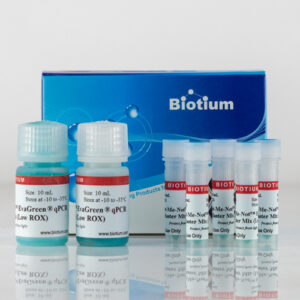
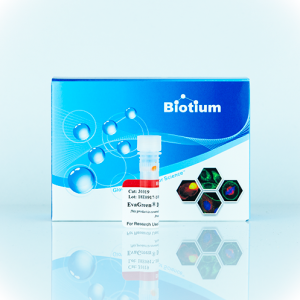
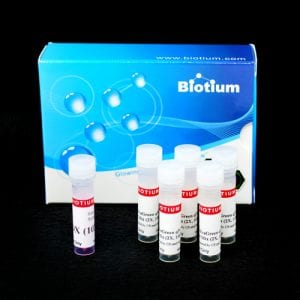
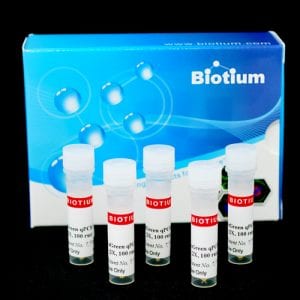
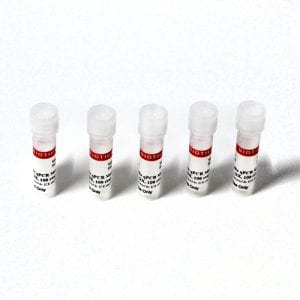
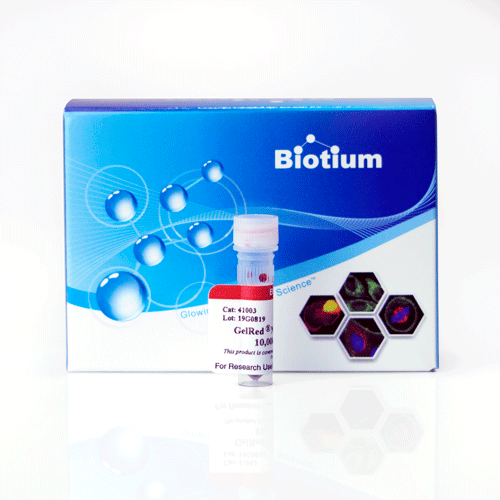
Biotium offers several EvaGreen® dye-based products, including stand-alone EvaGreen dye and EvaGreen® dye master mix products (See Table 1). Biotium's EvaGreen® dye technologies are available for licensing.
References:
1. Khan, et al. Detection of aacA-aphD, qacEδ1, marA, floR, and tetA genes from multidrug-resistant bacteria: comparative analysis of real-time multiplex PCR assays using EvaGreen® and SYBR® Green I dyes, Molecular and Cellular Probes (2011), doi: 10.1016/j.mcp.2011.01.004.
2. Cheng, et al. Detection of hemi/homozygotes through heteroduplex formation in high-resolution melting analysis, Anal. Biochem. 410, 158(2011).
3. White, et al. Methylation-sensitive high-resolution melt-curve analysis of the SNRPN gene as a diagnostic screen for Prader-Willi and Angelman Syndromes. Clin. Chem. 53, 1960 (2007).
4. Mao, et al. Characterization of EvaGreen Dye and the implication of its physicochemical properties for qPCR applications. BMC Biotechnology 7, 76 (2007).
5. Giglio S, et al. Demonstration of preferential binding of SYBR Green I to specific DNA fragments in real-time multiplex PCR. Nucleic Acids Res. 31(22), e136(2003).
6. Ohta, et al. Ethidium bromide and SYBR Green I enhances the genotoxicity of UV-irradiation and chemical mutagens in E. coli, Mut. Res. 492, 91(2001).
7. Karsai, et al. Evaluation of a homemade SYBR green I reaction mixture for real-time PCR quantification of gene expression. BioTechniques 32(4), 790(2002).
Much Safer due to Impermeability to Cell membranes
| A) 5 min. incubation | B) 30 min. incubation | C) 30 min. incubation, long photographing exposure time | ||
| SYBR Green I | ![]() |
![]() |
![]() |
Figure 3. Comparison of cell membrane permeability between EvaGreen® dye and SYBR® Green I. HeLa cells were incubated with SYBR® Green I (1.2 µM) or EvaGreen® dye (1.2 µM) at 37 oC. Photographs were taken following incubation for 5 and 30 minutes. SYBR® Green I entered cells rapidly while EvaGreen® dye appeared membrane-impermeable as evident from the absence of cell nuclear staining. Image taken with long photo-exposure time revealed that EvaGreen® dye only associated with cell membranes. . See full EvaGreen dye safety report |
| EvaGreen | ![]() |
![]() |
![]() |
|
EvaGreen® Can Be Optimally Excited by the 488 Ar
Laser or Blue LED Figure 4. Excitation and emission spectra of EvaGreen® in the presence of dsDNA in PBS buffer.
|
Table A. Ordering Information
Cat# |
Product Name |
Unit Size | Unit Price |
31000-T |
1 mL |
$40 |
|
31000 |
5 x 1mL |
$175 |
|
31002 |
1 x 1mL |
$420 |
|
31020 |
2 x 1mL |
$145 |
|
31015 |
2 x 1mL |
$145 |
|
31015-2 |
50 x 1mL |
$2875 |
|
31015-1 |
5 x 1mL |
$316 |
|
31015-T |
1 x 1mL |
$69 |
|
31014 |
2 x 1mL |
$145 |
|
31014-2 |
50 x 1mL |
$2875 |
|
31014-1 |
5 x 1mL |
$316 |
|
31014-T |
1 x 1mL |
$69 |
|
31020-2 |
50 x 1mL |
$2875 |
|
31020-1 |
5 x 1mL |
$316 |
|
31020-T |
1 x 1mL |
$69 |
| ** Price is for US enduser only. International price may vary. Please contact your local distributors for your price. |
* EvaGreen® and its uses are covered by pending US and international patents; SYBR is a registered trademark of Molecular Probes, Inc.
** Practicing HRM may require a license from Idaho Technologies, Inc.; SYBR, ResoLight, LC Green and BRYT Green are trademarks of Invitrogen, Roche, Idaho Technologies and Promega, respectively; EvaGreen technologies are covered by US patent Nos 7,601,498, 7,776,567 and other pending US and international patents.